Choosing the right music system for home is rarely as simple as picking a brand and a budget. For dedicated listening rooms or private cinema spaces, a full hi-fi music system with an AV receiver, separate speakers and professional calibration is the route worth taking seriously.
The choice sounds straightforward until you factor in room dimensions, ceiling height, furniture layout and how you actually use the system. AV Nirvana India is a premium AV distributor with over 17 years' experience delivering private cinema and professional installations across India. This guide draws on that depth of industry knowledge to offer a practical decision framework covering setup types, room size, budget tiers, connectivity and what professional installation actually involves.
Key takeaways
- Room size decides configuration:A 5.1 system suits most Indian living rooms between 150 and 300 sq ft; 2.1 is more honest for compact apartments where rear speakers cannot be placed correctly.
- Soundbar for TV, receiver for music:Soundbar packages excel at everyday TV and films; anAV receiver with separate speakerswins for music quality, multiple sources and long-term upgradeability.
- Calibration makes a real difference:Proper positioning and calibration can make a modest system sound better than a high-spec system left at factory defaults.
- Ceiling type matters for Atmos:Up-firing Atmos drivers work best against flat, reflective plaster or drywall ceilings between roughly 2.3 m and 4.3 m high; in-ceiling speakers are the stronger choice for textured, tiled or high ceilings.
Which type of home audio setup actually suits how you listen?
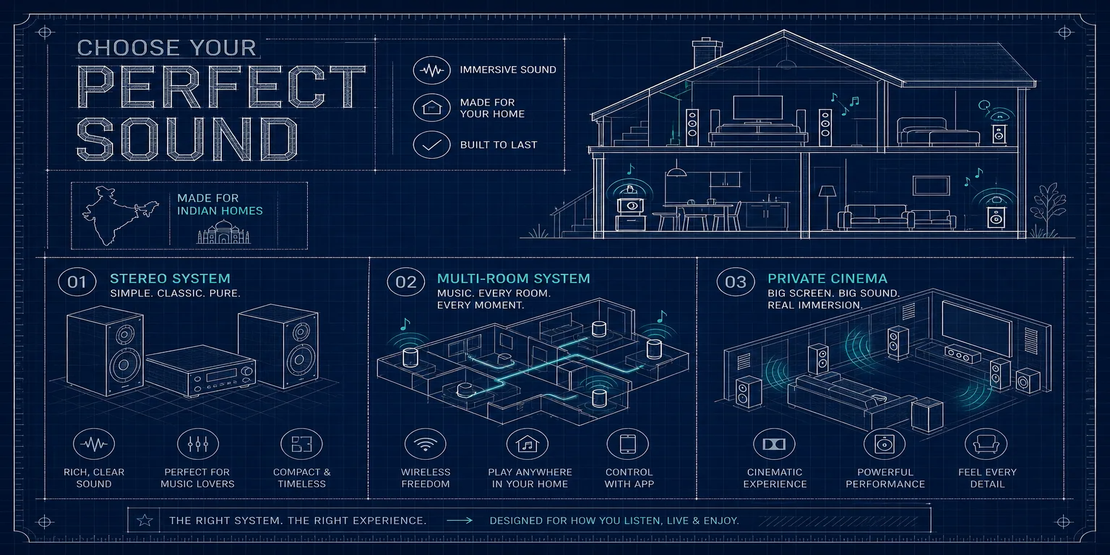
Before choosing a brand or a budget, it is worth identifying which of four distinct categories you actually need. Choosing the wrong category means no amount of spending will fix the mismatch between the system and the room or the listening habit it is supposed to serve.
Stereo hi-fi: the best home music system for pure listening
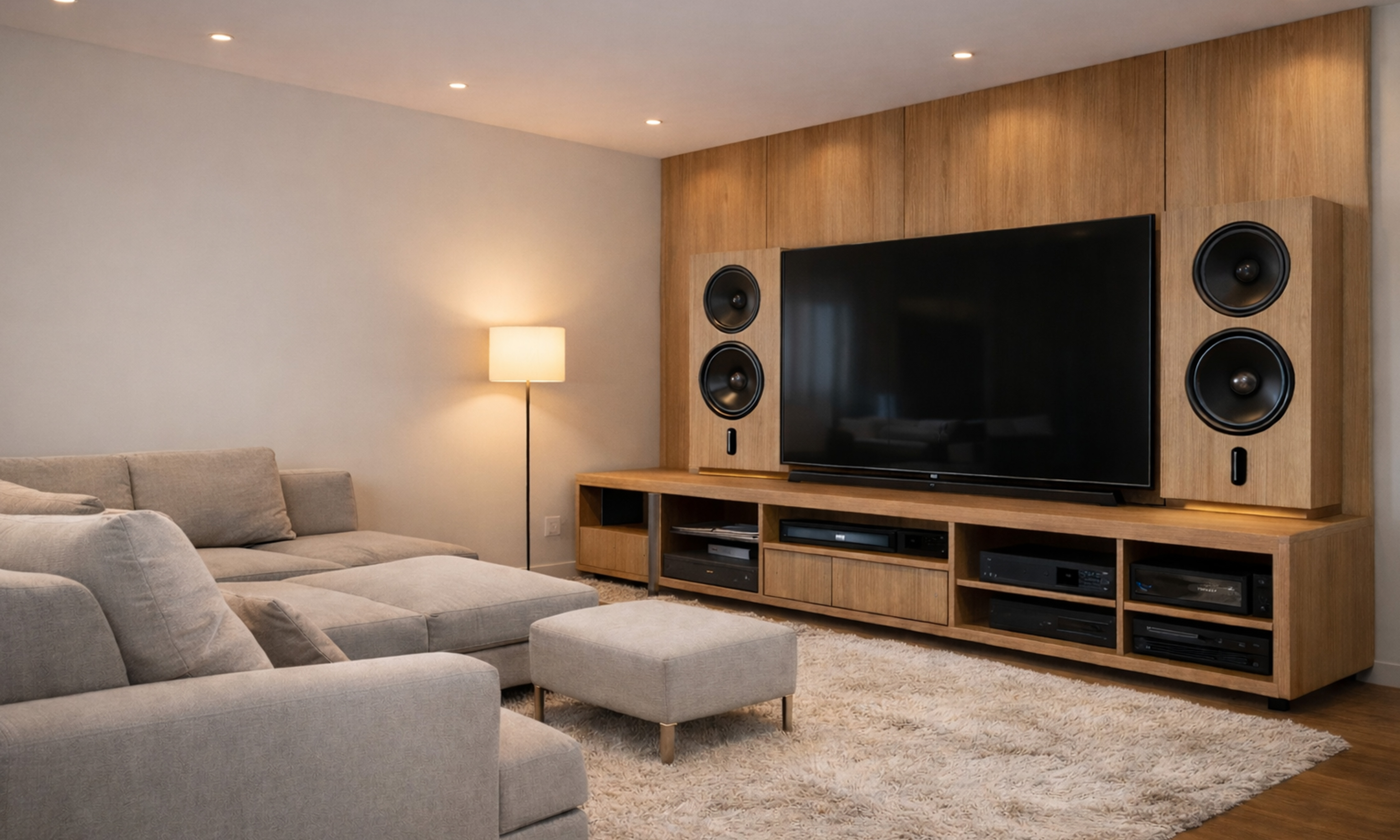
A two-channel system is an amplifier, a pair of bookshelf or floor-standing speakers and a source, nothing more. The reason stereo imaging, vocal presence and instrument separation feel so convincing through a proper hi-fi music system is that two well-positioned speakers, driven by a competent amplifier, create a coherent soundstage that multichannel systems often struggle to replicate for pure music listening.
Multi-room wireless: music that moves with you
Distributed audio places wireless speakers in multiple rooms and controls them from a single app. Ecosystems such as Sonos and HEOS-based Denon Home speakers fall into this category. This is a lifestyle system rather than an audiophile one, and it works best layered alongside a primary hi-fi or home theatre system rather than replacing it.
Soundbar with subwoofer: the living-room all-rounder
A soundbar package is the practical middle ground: a meaningful upgrade over a television's built-in audio, manageable cable runs and a compact footprint. Packages that include physical rear speakers, outperform purely virtual surround systems considerably. This is the right default for most buyers who watch films and television more than they sit down and listen critically.
Private cinema audio: when only a dedicated room will do
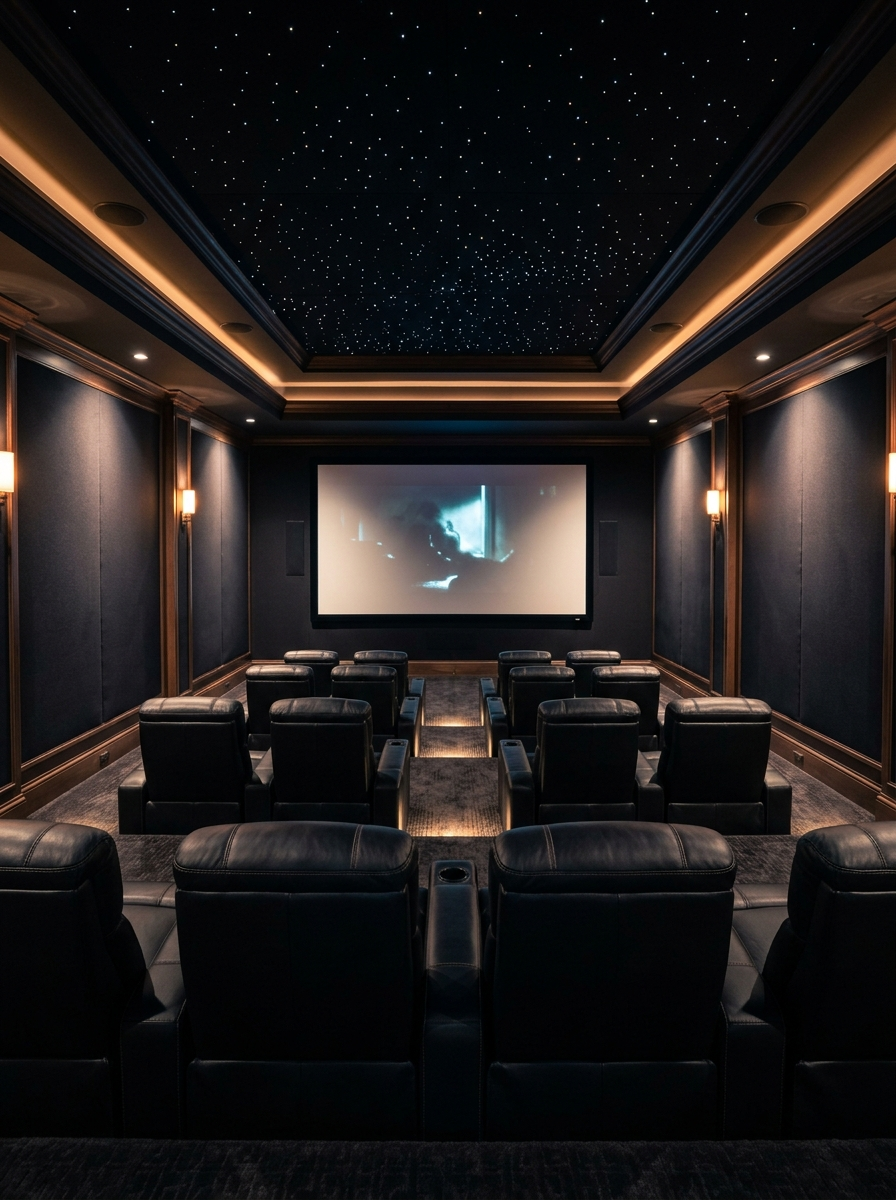
At the bespoke end sits a dedicated room with a 7.1.4 Dolby Atmos speaker layout, acoustic treatment, a pre/power amplifier chain and professional calibration. This is as much a design and architecture exercise as it is an AV project. We cover exactly how this process works in the AV Nirvana India section later in this article.
How does your room size and layout shape the music system for home you actually need?
Choosing a channel configuration that physically cannot work in the available room is the most common and expensive mistake buyers make. The room decides the configuration, not the other way around.
For rooms under roughly 150 sq ft, a 2.0 or 2.1 system is the honest recommendation. Two speakers deliver clear music and dialogue; a subwoofer adds convincing bass without crowding the space. In apartments where the sofa sits against the back wall, even a 5.1 layout often cannot be placed correctly, making 2.1 or a compact 3.1 the more practical choice.
A typical 2BHK or 3BHK living room at 150 to 300 sq ft suits 5.1 well: left, centre, right, two surrounds and a subwoofer. Surround speakers work best mounted around 1.1 to 1.2 m from the floor, slightly behind the listening position. A correctly positioned 5.1 system will outperform a badly positioned 7.1 every time, worth remembering before chasing a higher channel count.
Moving to 7.1 requires at least 12 by 18 ft of room and genuine space behind the seating for rear speakers. The step to 5.1.2 Dolby Atmos adds two height channels and works well with ceilings between 2.3 m and 4.3 m. The full 7.1.4 Atmos layout suits dedicated theatre rooms above roughly 400 sq ft. One important caveat for Indian homes: up-firing Atmos drivers rely on a flat, acoustically reflective surface such as plaster or painted gypsum; acoustic tiles, coffered ceilings or soft false-ceiling panels absorb the reflected signal and significantly reduce the effect.
How AV Nirvana India approaches a listening room project
If you have worked through this guide and moved from confusion to a shortlist, the natural next step is a conversation with someone who has done this for a specific room rather than in the abstract. That is what AV Nirvana India is built for.
A good room assessment considers dimensions, ceiling type and height, furniture layout, existing infrastructure, source preferences and how the space is used day to day. The same budget can produce very different outcomes depending on how the brief is written, this is where the right choices become obvious rather than theoretical.
AV Nirvana India sources world-class audio-visual equipment from leading global brands, working to match hardware to the specific room and use case. This includes amplification, speakers, source components, acoustic treatment and control systems, selected to work together as a coherent system rather than assembled from separate purchase decisions.
If you want to discuss your room, reach out to the AV Nirvana India team directly to get the conversation started.
The right music system for home fits your room, not just the spec sheet
A home music system is not about maximum wattage or the longest channel count. The right music system for home is the one matched to how you listen, how your room is shaped and how much you want to invest in getting the details right. For compact apartments, a 2.1 or entry-level 5.1 setup handles everyday listening well and does not require professional installation to work properly. For larger rooms and more serious listening habits, a full AV receiver system with separate speakers, acoustic treatment and professional calibration is the better long-term investment: it outperforms its price point precisely because it has been set up for the room it lives in.
For buyers who want a room designed around sound, whether that is a private cinema, a dedicated listening room or a multi-room installation across an entire home, that is the work AV Nirvana India was built for. The specification debates end once you have heard a properly designed system in a properly treated room. The best starting point is a conversation about the room.