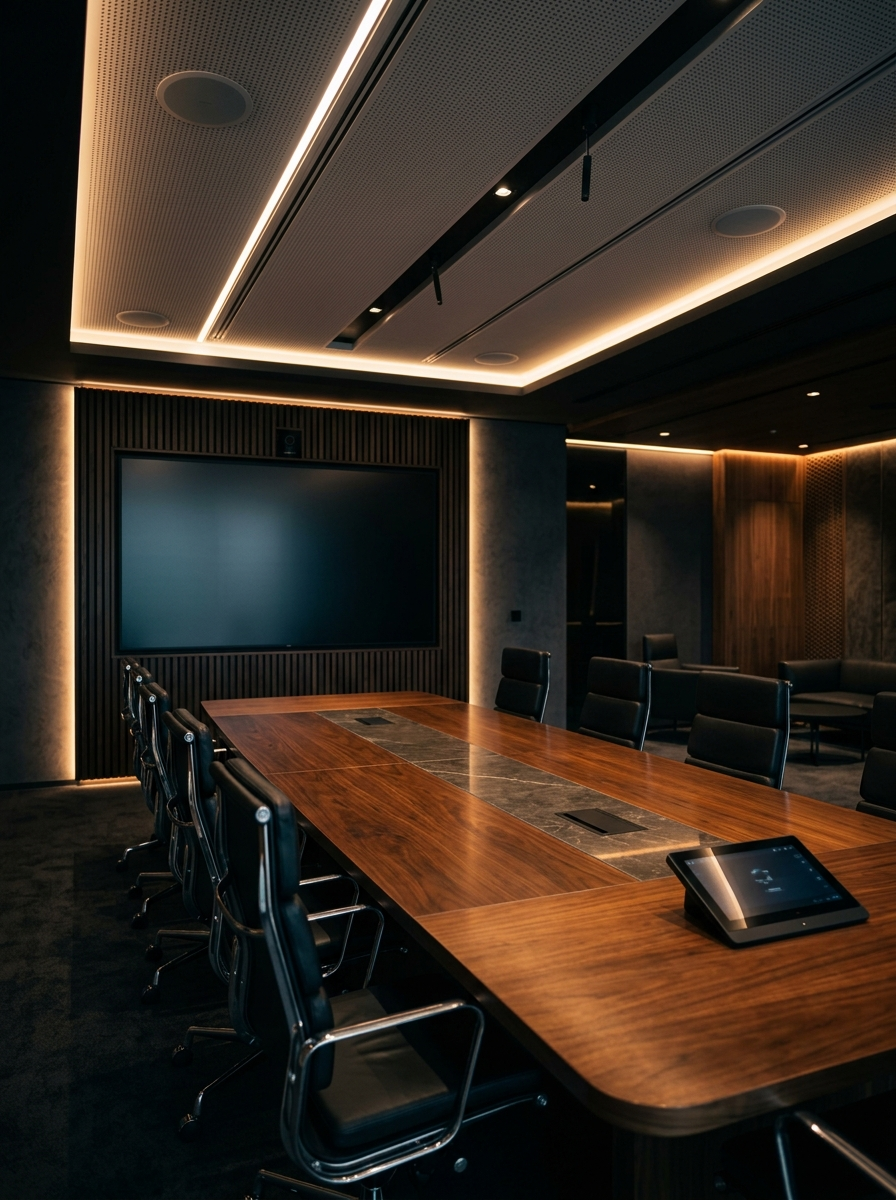
Video conferencing hardware has become remarkably good. Boardroom audio has not kept pace — not because the products are weak, but because the room and the signal chain are usually an afterthought.
Start with coverage, not microphone count
A single beamforming array in a 20-seat room will pick up the near end of the table beautifully and the far end as a rumour. Coverage is a geometry problem: map the seats, work out the pickup pattern of each microphone at the actual mouth-to-mic distance, and only then count the hardware.
Gain structure matters more than gear
The most common fault we are called in to fix is not a broken device. It is a chain where every stage is compensating for the previous one — a quiet microphone pushed hard at the DSP, then limited at the codec, then boosted again at the far end.
- Set unity gain through the DSP before touching any channel trim.
- Leave 18–20 dB of headroom for the loudest talker in the room.
- Gate conservatively. Aggressive gating clips the start of words and makes people repeat themselves.
Echo cancellation needs a stable reference
AEC works by subtracting a known reference signal. If the loudspeaker path changes — a volume knob after the DSP, a display with its own processing, a wireless link that drifts — the canceller is chasing a moving target, and the far end hears the room twice.
Get those three things right and the room stops being a topic of conversation. That is the only real measure of success.